
From classroom to construction: rethinking
apprenticeships
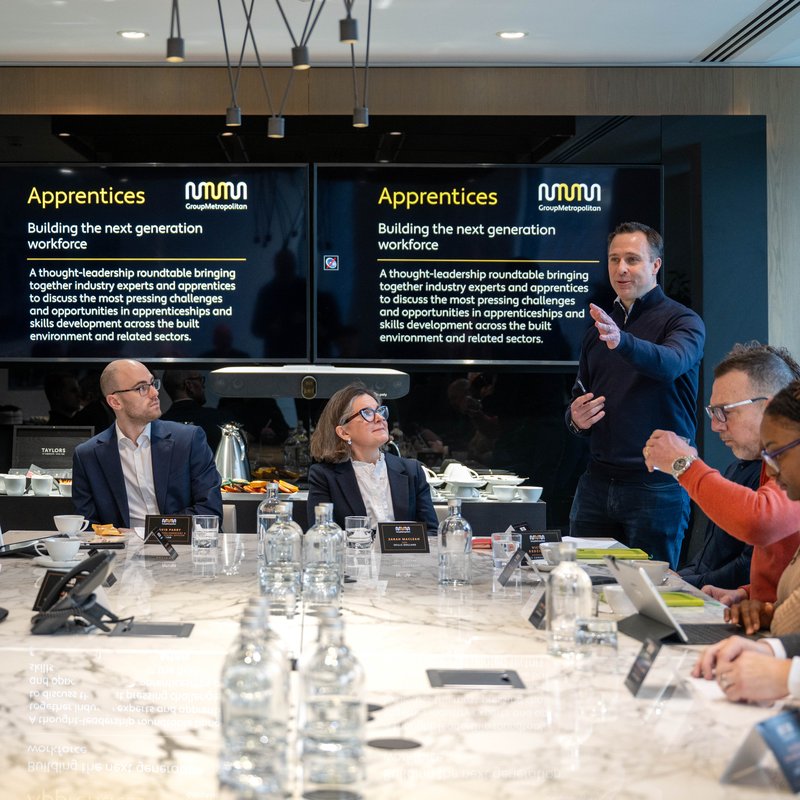
As part of National Apprenticeship Week, Group Metropolitan hosted a roundtable discussion at their City of London office, bringing together industry leaders and their apprentices, professional bodies and government to discuss the current state of apprenticeships within the construction sector. The session explored how young people access opportunities, the visibility of apprenticeships in schools, the challenges of recruitment, and the need for better industry‑wide communication.
The session was chaired by Richard Irwin, Director at RI‑ConX and GeN+1, and attended by senior representatives and apprentices from CBRE, AF Switchgear, AVK, BCS Consultancy, VISA, Gratte Brothers, and Group Metropolitan. They were also joined by David Parry of the Chartered Institute of Building (CIOB), and Sarah Maclean, CEO of Skills England, adding additional perspectives into the conversation.
Richard Irwin opened the session by welcoming attendees and highlighting the importance of apprenticeships to the future of the industry. He also introduced Gen+1, a global network supporting early‑career professionals in the data centre sector.
As introductions went around the room, it was clear that many of the senior leaders around the table had started their own careers as apprentices. From managing directors to technical directors and COOs, several shared career journey’s that began on the tools.
Why an apprenticeship?
To begin, Richard asked the apprentices in the group why they chose the apprenticeship route, rather than university. Robyn Gray, now a first‑year apprentice at Gratte Brothers, described a winding path; “I did accountancy, but it just didn’t match my personality, so I was looking elsewhere when my dad, a plasterer himself, suggested a trade.” Even once she knew what she wanted, the process wasn’t straightforward, “finding Gratte Brothers was not easy. I had to go through a tunnel of stuff…but eventually I got there.”
Others faced similar challenges. Apprentice, Austin Warriner from AVK said he applied to “loads and loads of companies” straight out of sixth form, often with little feedback. Jack Laker from Group Metropolitan admitted he was “quite lucky” because a family connection helped him get a foot in the door, something he recognised many young people don’t have access to.
This reliance on networks struck a chord. As Simon Harris, Director of critical infrastructure at BCS Consultancy added, “You find these opportunities by accident or referral… sometimes your parents’ network becomes the key difference.” The table agreed that fair access to opportunities is an issue that needs to be addressed .
Exposure to the industry.
Employers also face many challenges in recruiting apprentices. Graham Halls, Managing Director at Group Metropolitan, explained that before introducing trial periods, they often took on apprentices who didn’t fully understand the reality of the job. “We’d take six on and three wouldn’t stick,” he said. Now, they bring in a larger group for two weeks between exams and the start date, to shadow all the trades, seeing what the work is really like. “It helps both sides,” he said. “We want people to stay, but they need to know what they’re signing up for.”
Does the problem start at school level?
A major point of discussion was the lack of meaningful apprenticeship information in schools. David Parry, Senior Parliamentary & Public Affairs Officer from the Chartered Institute of Building (CIOB) shared research showing that nearly half of young people receive little careers advice about the construction industry. “We surveyed 16 to 24 year olds and nearly 50% said that they’d received no careers advice on construction at school.”
Apprentices in the room confirmed this; “at my school, it was never an option,” Jack Laker said. “Universities came in all the time, but construction was kind of frowned upon, like it was second best.” Robyn Gray agreed: “In school, it’s not part of the curriculum. Wood tech was just playing with toys.” Senior Director of Data Centre Engineering and Ops at VISA, Joe Searle, agreed; “universities and apprenticeships should be offered at the same time, not just as a backup often for those who don’t get in” he added.
There was strong criticism of the limited training and industry exposure provided to teachers in schools and colleges, with a widely held view that the UK does not currently have enough high-quality, construction-specific education provision to meet industry needs. Richard Harris, Labour Manager at Gratte Brothers, recalled asking teachers what they thought construction involved, to which “they said bricks… and electricity. They haven’t got a clue.”
Apprentice at VISA, Dom Humphery added to the misconception of apprenticeships, “it’s definitely considered a backup, still today.” Adding that some of the smartest people he knows have gone into apprenticeships, "this attitude needs to change”.
The benefits of University Technical Colleges was introduced to the conversation by Paul Hood, COO at AVK, and one of the founders of Heathrow University Technical College. “It gives students exposure to the industry”. Sponsored by universities and employers, students are given an “extra day a week to be taught about each of the trades, and construction industry as a whole, while also following the educational curriculum.” This was further advocated by Terry Truman, Technical Director at CBRE Data Centre Solutions, who believes that “we should be helping by giving students training and teaching on trades alongside an education,” allowing students to be practical while also getting the necessary grades in Maths and English.
Sector scale
Another theme was the sheer scale and diversity of the industry, something rarely understood by the next generation. Dom Humphery reflected on how narrow his own understanding was when he started: “If you’d asked me what a QS was, I’d have guessed.”
Bringing a government perspective, Sarah Maclean, CEO at Skills England, added “there’s a big investment from the government for large infrastructure projects at the moment, so the pipeline is going to need guys like you.” This is magnified with the impact and influence of AI on particular professions.
Richard Irwin noted that young people today often turn to social media for career inspiration. His own son, he said, views Instagram and TikTok to understand what different jobs look like. “There’s a day in the life for teachers, doctors, librarians, but where’s the day in the life for an apprentice electrician?”
This sparked a broader discussion about the need for a coordinated, modern communication strategy. David Parry suggested the industry could learn from the armed forces’ recruitment campaigns: “We need something like ‘I was made in the Royal Navy’, but for construction.”
Apprenticeships are a pathway
One of the strongest messages came from those who had completed their apprenticeships years ago. Many described how their apprenticeship was just the beginning, and stepping stone to a more senior role within the construction industry.
“I started as an apprentice 28 years ago,” said Graham, now Managing Director of Group Metropolitan. “In 20 years’ time, Jack, hopefully you’re sitting here.”
Paul Hood, who also began as an apprentice before moving into global leadership roles, put it simply: “I love the industry. It’s a great thing you’re doing.”
However, it was noted that the workload and responsibility increase (as in any job), as you move up through your apprenticeship says Hussein Viramgamwala, Apprentice at CBRE Data Centre Solutions; “the support function is always there, but slowly drops off every year that you are an apprentice at the company.”
AF Switchgear apprentice, Reuben Lowe noted “I not only have my manager but also other apprentices above and around me – all together we can support each other.”
What support is needed
The question is, what can ‘we’ do to improve? Sarah Maclean offered a government insight into the future of apprenticeship, highlighting a persistent challenge. “The construction sector is made up of 98% SME’s - but with so many apprenticeships being word and mouth, that isn’t working.” She pointed to the opportunities available through the Skills England website, where live vacancy data is published. “Unless companies tell us what openings they have, we can’t support.”
Sarah also outlined a new government initiative aimed at fast‑tracking apprenticeship approvals and improving the signposting of routes into apprenticeships – all small but important steps forward.
From an industry body perspective, David Parry emphasised the ongoing struggle to turn policy into action. “The government can set the policy, but we've got to be the ones who take the action.”
Others around the table echoed the need for clearer communication to support apprenticeship schemes and nurture the next generation of industry leaders. Paul Garrard, Production Manager at AF Switchgear, noted: “There is often a lack of organisation and communication between the apprentice and the college, and then the college and the working companies.”
The issue of colleges and training providers was raised almost unanimously amongst the apprentices, with almost all of them experiencing some form of delay to their learning due to a tutor’s long term absence, or multiple changes in training officers. The lack of tutors able to pick up the slack meant that some apprentices were told not to attend college for up to 6 months and impacted their ability to earn increased wages. Sarah Maclean agreed that this was “something that the Government need to address, but require additional support from the private sector to help fill the void.”
Observing the discussion, Chris Ellis, Commercial Director at Group Metropolitan, added that the industry must match the government’s efforts. “As an industry, we need to push this just as much as the government. The first step into this is promoting apprenticeships in schools and making sure that the younger generation see trade apprenticeships as a strong career path, not a back-up option.”
The roundtable highlighted both the strengths and the gaps in the current apprenticeship system. The passion for apprenticeships is there from those ‘in the know’, both from those who are just starting out, and those who have built entire careers on them. But the challenges are equally clear, with limited visibility in schools, reliance on personal networks, and outdated perceptions for those joining apprenticeships and the opportunities for career progression.
What came through most strongly was a shared belief that apprenticeships are not a fallback – they are a respected, and potentially future‑proof, route into an industry that is full of opportunity. As Victor Kedzierski, apprentice at BCS Consultancy put it “if you are unsure in any way, about that to do – just speak to as many people as possible and get involved.”
The task ahead is ensuring that many more young people get the chance to do just that!